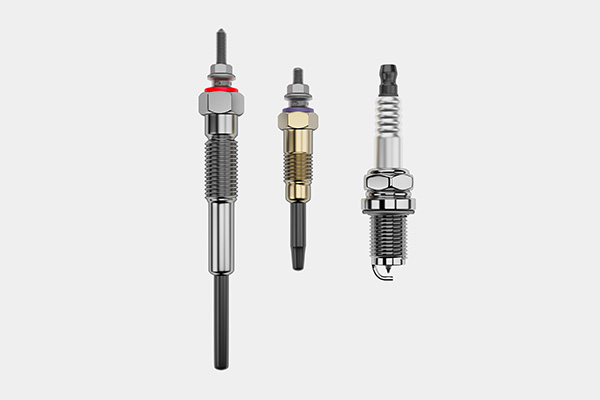
If you have ever wondered whether your diesel truck has spark plugs, you are not alone. Spark plugs and glow plugs sound similar, and both live in the cylinder head, but they do very different jobs. Knowing how each one works helps you understand cold start issues, misfires, and why the maintenance schedule is not the same for gas and diesel vehicles.
How Gasoline Engines Use Spark Plugs
Gasoline engines rely on a controlled spark to ignite the air-fuel mixture. Each cylinder has a spark plug threaded into the head, and an ignition coil sends high voltage to jump the gap at the tip of the plug. That tiny spark happens thousands of times per minute while you drive, and timing has to be very precise for smooth power and good fuel economy.
Spark plugs live in a tough environment. Heat, pressure, and combustion deposits slowly wear the electrodes and insulator. As the gap gets wider and the tip gets dirty, the spark becomes weaker and less consistent. That is when you start to feel misfires, hesitation, or a rough idle, especially under load or on cold mornings.
What Glow Plugs Do in Diesel Engines
Diesel engines work differently. Instead of using a spark to light the mixture, they compress air until it gets hot enough to ignite fuel on its own. In warm conditions, compression alone is enough. In cold weather, or on certain engine designs, the compressed air and metal surfaces are not quite hot enough for a clean start.
Glow plugs are small electric heaters that help during those first few seconds. When you turn the key on, power flows to each glow plug, warming the tip and the air around it inside the pre-chamber or combustion area. That extra heat lets injected fuel ignite more easily, so the engine starts without a lot of smoke or stumbling. Once the engine is warm, most diesels barely use the glow plugs at all.
Key Differences Between Spark Plugs and Glow Plugs
It can be helpful to think of spark plugs and glow plugs side by side:
- Spark plugs create a spark every power stroke while the engine runs. Glow plugs mostly work before and just after start up.
- Spark plugs ignite the mixture in gasoline engines. Glow plugs simply help heat the air so diesel fuel will ignite from compression.
- Spark plugs depend on strong ignition coils and a correct gap. Glow plugs depend on a good power supply, relays, and control modules.
- Spark plug problems usually cause misfires at idle or under load. Glow plug problems usually show up as hard cold starts and white smoke.
The parts may look similar at a glance, but their role in the engine is very different.
Cold Start Behavior: What Drivers Feel
From the driver’s seat, cold start symptoms can tell you a lot about which system is unhappy. A gasoline engine with worn spark plugs often cranks at a normal speed, fires weakly, and may stumble for a moment before it smooths out. You might feel a light shake at idle or a hiccup as you pull away from a stop.
A diesel with weak glow plugs tends to crank longer than usual before it fires. On very cold days, it may crank, pause, then finally catch with a lot of white or gray smoke from unburned fuel. You might notice a glow plug or preheat warning light acting differently than it used to, staying on longer or flashing. Those patterns give our technicians useful clues before we ever pick up a tool.
Common Problems and Warning Signs for Each Type
Spark plugs and glow plugs fail in different ways, but both give you some hints before they quit completely:
- Rough idle or shaking at stoplights on a gasoline engine
- Hesitation or stumbling when you accelerate, especially up hills
- Noticeable drop in fuel economy with no other changes
- Check engine light with misfire codes or ignition-related codes
- Long cranking on a diesel when the weather turns cold
- Excess white smoke and rough running right after a cold start
- Glow plug warning light that stays on, flashes, or never comes on at all
If more than one of these shows up, it is usually time to have the ignition or preheat system checked instead of waiting for a complete no-start.
Basic Maintenance Tips for Spark Plugs and Glow Plugs
Both types of plugs last a long time, so it is easy to forget about them until there is a problem. Following the service schedule in the owner’s manual is a good starting point, but real-world driving matters too. Hard use, lots of short trips, and heavy towing can all justify replacing spark plugs a bit earlier than the maximum recommended mileage.
For diesels, glow plugs should be checked when you start to notice longer cranking in cold weather, or any time the glow plug light behaves oddly. It is also smart to test the control module and wiring, not just the plugs themselves, because we often find more than one weak link in older systems. At our shop, we like to check plug condition whenever we are already deep in the engine bay, since how those parts look can reveal how the engine has been running.
Get Spark Plug and Glow Plug Service in Covington, WA with Valley Automotive
We work on gasoline and diesel vehicles every day and know how spark and glow plug issues really feel from behind the wheel. We can test, inspect, and replace worn plugs, then check related wiring and control modules so your engine starts quickly and runs smoothly in all seasons.
Call Valley Automotive in Covington, WA, to schedule spark plug and glow plug service and keep your ignition and cold-start systems in top shape.